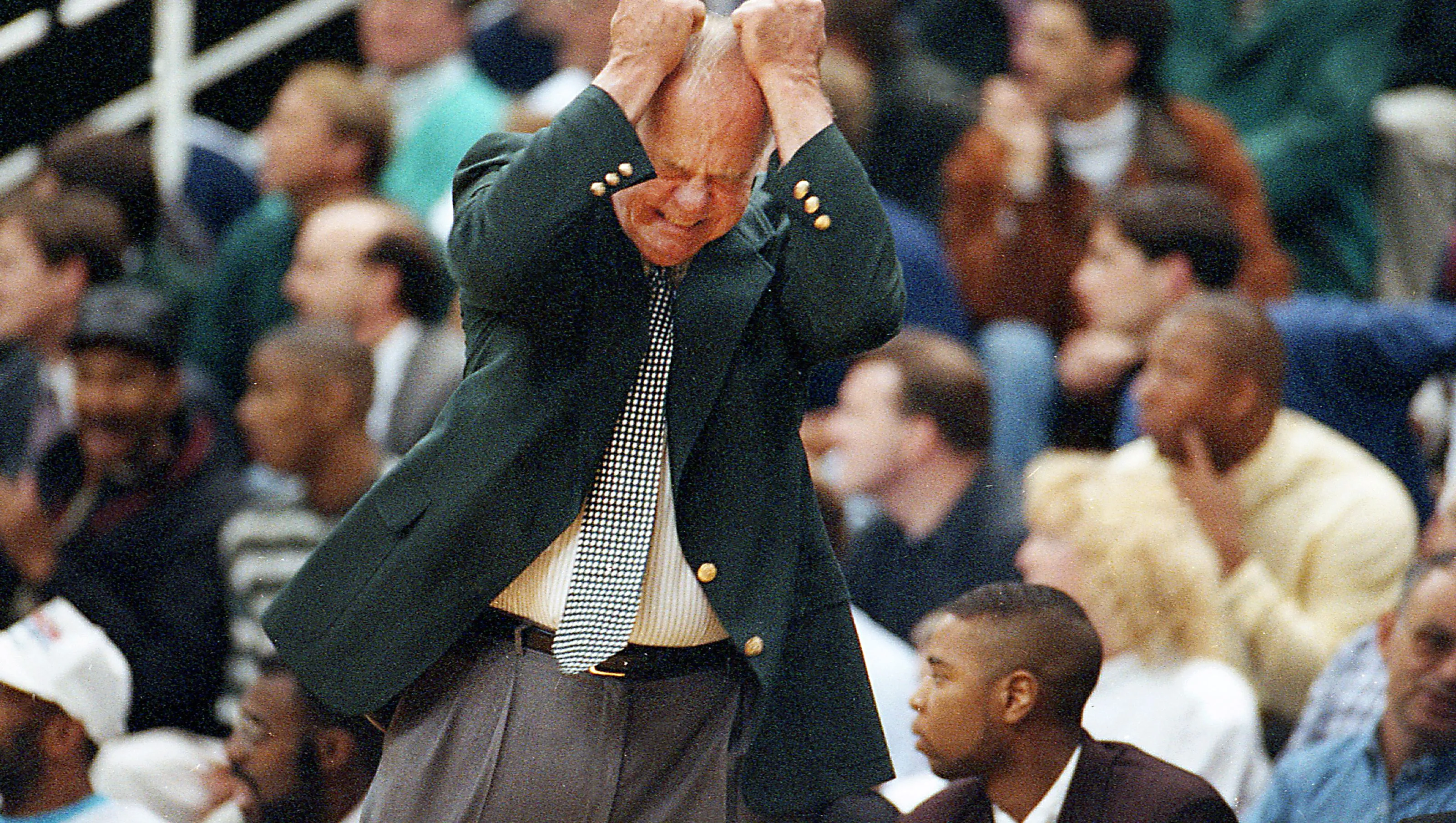
Late Great Michigan State Legend Jud Heathcote Recalls College Basketball’s Greatest Game
SPOKANE, Wash. — When the college basketball season tips off each year, fans all across the country think back to one night and one game when NCAA basketball stepped into millions of homes across the nation and became the spectacle it enjoys more than 40 years later. And North Dakota had a front row view of that historical night.
“Looking at it at the time, we didn’t realize the importance of the game,” said Jud Heathcote, whose Michigan State Spartans upended Indiana State 75-64 to win MSU’s first-ever NCAA basketball championship.
The game, which remains the most-watched game in Final Four history, matched two players, who are cemented in college basketball history, and whose professional basketball shadows are virtually unmatched.
Larry Bird, a transfer from Indiana University, had led the Sycamores to a perfect record and a No. 1 national ranking heading into the tournament. A young freshman by the name of Earvin Johnson was the catalyst for the Spartans, who entered the tournament with a No. 3 ranking.
Bird vs. Magic. Magic vs. Bird. No matter how the rivalry is viewed, it got its start on that night in 1979 in Salt Lake City. The rivalry later carried over as the two players became fixtures in the NBA.
“Magic and Bird are two of the greatest pro basketball players of all time,” said Heathcote, who was born in Harvey, N.D.
Johnson was one of three Spartans in double figures in the championship game. He finished with 24 points and was voted most outstanding player of the tournament. Bird scored 19 as the Sycamores came one game short of going undefeated on the season.

EARLY YEARS
Three years after his birth in 1927 on the plains of North Dakota, Heathcote was put on a train, along with an older brother and sister, to live with their maternal grandparents in Manchester, Wash. The move came just one year after Heathcote’s father, Marion, and a younger brother died during a diphtheria epidemic.
“After my dad died, mom tried the best she could to keep the family together,” Heathcote said in a 2009 interview while living in Spokane, Wash. after retiring as coach at MSU following the 1994-95 season. “She worked hard to make ends meet, but making $12 a week. or $48 a month just wasn’t enough.”
So, Heathcote’s mother put the three children, ages 3, 4 and 5 on a train from Fargo with the porter in charge of the trio of toddlers. destined for the Great Northwest, where he remained for much of his early life. He coached basketball at West Valley High School, in Spokane, for 14 years before becoming an assistant coach at Washington State University, where he remained for seven seasons.
While at WSU he was greatly influenced by legendary Cougar coach Marv Harshman, a Naismith Hall of Famer.
“What (Harshman) taught me is that coaching is not a job, it’s a privilege,” Heathcote said. “I think in my entire life I maybe went into the office three times when I really didn’t want to be there. I truly enjoyed what I did.”
Heathcote left Pullman, Wash. to become the head coach at the University of Montana in 1971 and led the Grizzlies to a 14-12 record in his first season and a 13-13 mark the following year. In 1974-75, Heathcote led Montana to its first-ever Big Sky Conference championship and a berth in the NCAA tournament. The season ended with a narrow 67-64 loss to UCLA, coached by another coaching legend, John Wooden, who would retire just weeks later after leading the Bruins to their 10th NCAA title.
It was while at Montana that Heathcote made his first return to his native North Dakota. And the homecoming, according to Heathcote, was not necessarily by design.
“I never got back until I was at Montana,” he explained. “I was recruiting a high school player by the name of Alan Nelson, who played at Westby. I had to fly into Williston and rent a car to get to Westby.”

MICHIGAN STATE
Heathcote left Missoula the following year after five seasons, a 78-53 record and a pair of Big Sky championships and took over the Michigan State program. He led the Spartans to a 12-15 mark in his first season and turned things around in a big way the following year as the Spartans finished 25-5 just months before Magic arrived on campus, putting the wheels of history in motion.
“(Magic) was a Lansing kid, but recruiting him was difficult,” said Heathcote of arguably his most famous recruit. “Michigan waged an all-out war on the recruiting trail. But, in the end, I think his heart was always at Michigan State.
“I convinced (Magic) that he could be our guard and run the show,” Heathcote added.
That “Show,” let alone championship season at MSU, almost never materialized, according to the former North Dakotan. After a successful trip to Brazil, minus Magic, who was competing with a 19-Under all-star team, during the preseason that ended with the team earning a medal, the Spartans returned home and began the season at 4-4 in the Big Ten.
“We lost on last-second shots at Illinois (57-55) and at Purdue (52-50) … and Michigan made a foul shot after regulation to beat us (49-48),” Heathcote recalled. “When we lost at Northwestern by 18 (83-65), it looked like we weren’t going anywhere. But, we got our fast break going and went on a winning streak.”
The Spartans’ magical run began as the team won 10 games in a row following the loss to the Wildcats. The streak was snapped with an 83-81 loss at Wisconsin in the regular season finale, but MSU entered the NCAA tournament as one of the hottest teams in the nation and were never seriously challenged in the tournament.

The Spartans were ranked No. 3 in the final AP poll. LSU, which Michigan State would defeat in the second round of the tournament, was ranked No. 9, was coached by another North Dakota native, Dale Brown (Minot), while Iowa, coached by Lute Olson (Mayville) was ranked 20th. Olson would later win an NCAA title while coaching Arizona.
The final AP poll in those days was released at the end of the regular season and prior to the start of the NCAA tournament.
Tournament wins over Lamar (96-64), LSU (87-80) and Notre Dame (80-68) propelled the Spartans into the Final Four. A convincing 101-67 win over Pennsylvania, set up the showdown with Bird and the Sycamores.
In the locker room, following the title game, Heathcote defused what could have been a controversial situation when a reporter was seeking comments from the winning Spartans.
“This guy is running around the locker room trying to get our players to say something negative about Bird,” Heathcote said. “He wanted to know what we thought about (Bird) letting his team down. He turned out to be a freelance writer and I told him to leave the room or I would pick his (posterior) up and remove him myself.
“Even though we didn’t know the implication of the game at the time,” Heathcote added., “we now know that those two guys (Bird and Magic) saved professional basketball. They both showed how the pass is more important than the basket. Magic is the best guard ever to play the game and Bird is easily one of the greatest that has ever played. Both truly left their mark on the game.”

Heathcote retired from coaching following the 1994-95 season. He logged a 340-220 record in his 19 seasons in East Lansing and led the Spartans to three Big Ten titles. He later underwent two open heart surgeries.
“After the first one, I developed an infection of a valve,” he explained during that 2009 interview. “My heart was operating at 15-25 percent efficiency, so they had to go in and do it again. I am 82 years old now and play about 80 rounds of golf a year … I guess (surgery) worked.”
The Harvey native said he had some trouble adjusting to not being on the bench of a college basketball team after he hung up his whistle for the final time.
“I had an awful time the first couple of years,” Heathcote said. “I found myself to always be second-guessing the coaching. I am getting better, but you can never take the coaching out of the coach.”
He said several things have changed in the game in the years since he left East Lansing.
“The 3-pointer and the shot clock have changed the way the game is played,” he said. “And, the jump shot off the dribble has become a thing of the past. Today it’s all about going to the basket.”
Heathcote said the biggest difference in today’s game is in the athletes themselves.
“The biggest difference is the readiness of the players when they arrive on campus,” he said. “Today’s players are so much bigger and stronger.”
The Big Ten, one of the best college basketball conferences in the nation, also afforded Heathcote the opportunity to forge rivalries, as well as some friendships within the league. Bobby Knight was one of those coaches who became close to Heathcote.
“Bobby has the ability to rub people the wrong way,” Heathcote said of the former Indiana coach. “(Knight) didn’t let too many people become his friend, but he and I became pretty good friends.”
Knight, according to Heathcote, got the upper hand by winning 20 of the 39 meetings between Indiana and Michigan State.
But, it was an April meeting in Salt Lake City in 1979 that made Magic, Bird … and Heathcote, household names for all time.
Heathcote died on Aug. 28, 2017 in Spokane at the age of 90.
A native of Bismarck, N.D., Ray is a graduate of North Dakota State University where he began studying athletic training and served as a student trainer for several Bison teams including swimming, wrestling and baseball and was a trainer at the 1979 NCAA national track and field championship meet at the University of Illinois. Ray later worked in the sports information office at NDSU. Following his graduation from NDSU he spent five years in the sports information office at Missouri Western State University and one year in the sports information at Georgia Tech. He has nearly 40 years of writing experience as a sports editor at several newspapers and has received numerous awards for his writing over the years. A noted sports historian, Ray is currently an assistant editor at Amateur Wrestling News.
