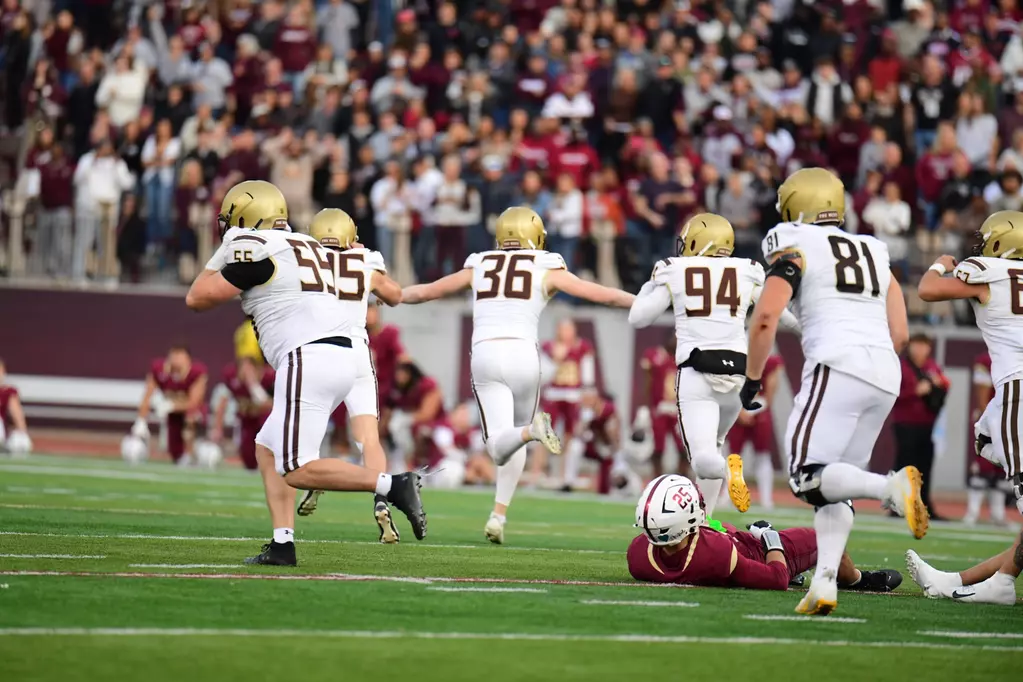
RIVALRY 162: A RECORD 38 YEARS IN THE MAKING – Lehigh Outlasts Lafayette in 51-48 Overtime Classic
EASTON, PA – In the fall of 1988, a freshman on Palmer Hall gathered with his new hallmates and friends in his Gryphon’s dorm room.
That freshman was me.
Jim, our Gryphon, was an upperclassman who served as a mentor and resource for first-year students living in the residence hall. Every so often, as I remember it, a few of us would wander into his living area to hang out and shoot the breeze.
It was a heady time for Lehigh and Lafayette football. As freshmen, we were only vaguely aware of Division I-AA football in general, its playoffs, or all that entailed. We sort of knew the Engineers (as Lehigh teams were still most commonly called back then) and Leopards were members of a brand-new league called the Colonial League, and that Lehigh’s brand-new Goodman Stadium was a beautiful, million-dollar temple of Lehigh-sized college football.
We had an idea Lehigh had a good team. Or, more accurately, a great offense.
But Jim explained the basics to us. Lehigh competed in Division I athletics, the same overall NCAA division as Penn State, but played football in the I-AA subdivision, where smaller Division I programs competed.
I-AA definitely didn’t mean “cheap.” The football program’s profile was rising, and games that season attracted thousands of fans. I know because I went to my first Lehigh football game that year. The Mountain Hawks hosted “Towson State” (as it’s listed on the ticket stub I still have) on Saturday, October 22, 1988, with a 1:30 p.m. kickoff.
My hallmates, Jim and I did a lot of following of Lehigh football that year, a great bonding experience for an awkward freshman who was looking for connection. I remember tuning into SportsCenter to see whether ESPN would list the Lehigh score in the crawl at the bottom of the screen. When we learned Lehigh had beaten Davidson 43-31, we cheered.
Someone in Jim’s room that evening asked him about the big game in November – the one we had heard about, thee biggest game on the Lehigh schedule every year. I recall Jim told us to expect craziness during Lehigh/Lafayette week. Parties on Fraternity row. Bed races. A bonfire. Free flowing food and drinks during the tailgate before the game. The Marching 97 crashing class and playing Lehigh fight songs in classes around campus. As an 18 year old freshman, it all sounded amazing.
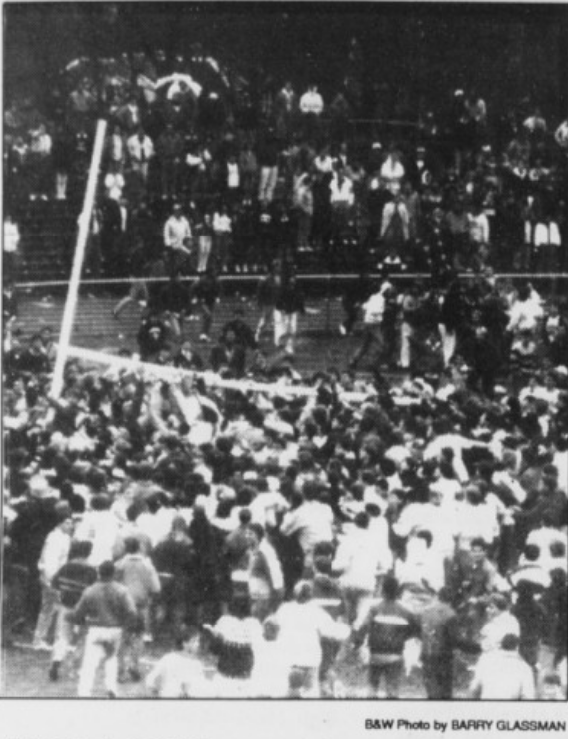
Most important to us, though, was something that had nothing to do with the game. Sure, everyone wanted Lehigh to win. Bragging rights over Easton, and all that. “Lafayette Sucks.” But as big as the game was the aftermath – storming the field to get souvenirs from the game, such as the end zone markers and bits of the goalposts.
This postgame mayhem was considered a “tradition” of Lehigh/Lafayette. In fact, Lafayette had brought in 60 additional security guards from Burns International Security, the company that provided security at the Meadowlands, to supplement its own personnel. As I remember it, the metal goalposts had been replaced by wooden ones to make them easier to tear down. Fights over memorabilia, and sometimes fights for no particular reason, had become part of the postgame tradition.
Filled with alcohol and adrenaline, we took a bus to Easton ready to watch our first ever Rivalry game. And boy, was it memorable. There was no Colonial League title on the line – Lafayette had wrapped up a share of a title the previous week. There was no playoff autobid or at-large bid at stake – the Leopards had fallen out of the I-AA Top 25 after a loss to Penn – but the Leopards wanted an outright league championship. For Lehigh, they just wanted to show out and beat their hated Rivals, just like they did the prior year 17-10 in the very last game at frigid Taylor Stadium.
The Morning Call‘s account the following day described the game as a “spectator’s delight and a defensive coordinator’s worst nightmare.” Lafayette head coach Bill Russo thought it must have looked like a tennis match from the stands.
It wasn’t an exaggeration.
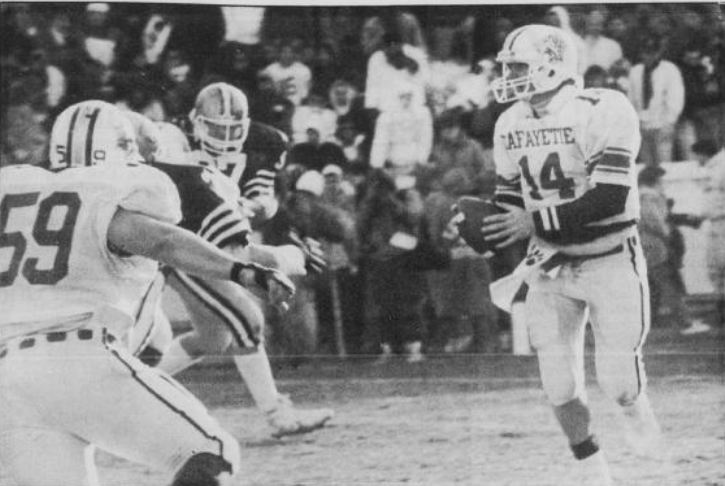
In front of a sold-out crowd of 17,500 fans, Lehigh opened the game with a 91-yard touchdown drive, with QB Jim Harris completing all seven of his passes for 77 yards. Lafayette answered with a touchdown of its own, and the two offenses kept trading scores. Lehigh scored touchdowns on each of its first five possessions, while Lafayette scored four touchdowns and added a field goal during its first five possessions.
Harris was nearly unstoppable in the first half, completing 23 of 29 passes for 372 yards and two touchdowns. He came within one yard of an NCAA record for passing yards in a single half. Lafayette QB Frank Baur wasn’t exactly struggling, either, finishing the afternoon with 309 passing yards and four touchdowns. Lafayette freshman RB Tom Costello added 216 yards on the ground.
Lafayette took its first lead on the opening possession of the second half. The Leopards eventually extended their advantage after Lehigh’s unsuccessful fake punt in the fourth quarter gave them the ball at the Mountain Hawks’ 27-yard line. Lafayette turned the opportunity into points and held on for the 52-45 victory.
The security effort kept most students off the field until the final whistle, but it didn’t eliminate the violence afterward. Emergency personnel treated approximately 10 students from the two schools, with one student from each school transported to the hospital. One unnamed official told the Lehigh student paper, The Brown and White, that some fights continued for as long as an hour and a half after the game.
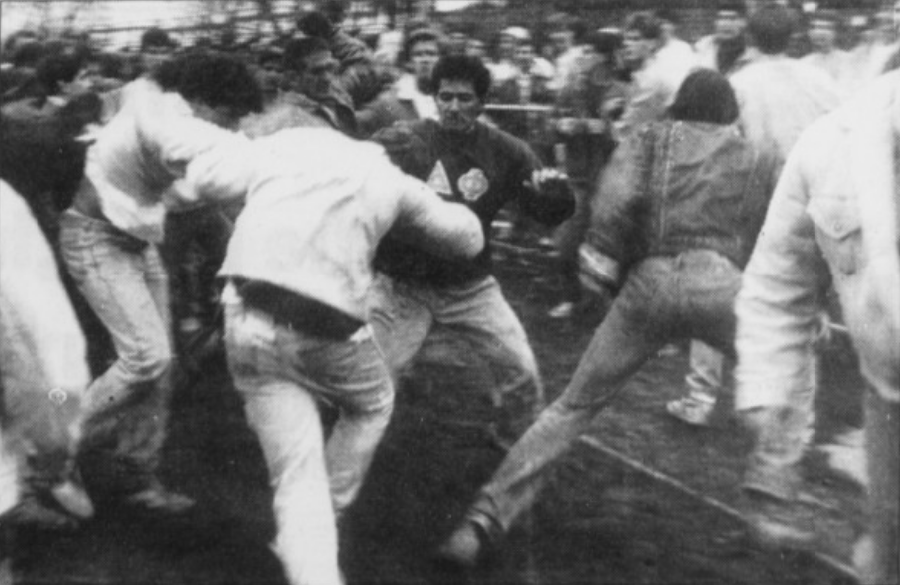
After storming the field with my buddies, I managed to get one of the end-zone markers. (Which was stolen from me by some girl, but that’s a story for another time.) It was exhilarating. Fraternities came away with large chunks of the goalposts, carrying them on their shoulders through the Pierce Street entrance. Stories on the way home involved the postgame mayhem, avoiding the fists of Lafayette fans, who managed to grab pieces of the goalposts, and which fraternity had scored the biggest prize. And, of course, there was the sting of defeat.
Despite the loss, all of us generally froze our tails off in an all-day and all-night party. It was glorious. It introduced me to the Rivalry. And since that day, I never stopped going.
When I left the stadium that evening with the pylon – my trophy – I had just seen the highest-scoring Lehigh/Lafayette game in history. Previously, Lehigh’s 78-0 throttling of Lafayette in 1917 was the highest scoring game in Rivalry history, and the 97 point track meet I watched outscored that contest by 19 points.
When I showed up at Fisher Stadium this past Saturday, walking past cornhole games, a tailgate where someone had hooked up a large screen TV with the broadcast of the game, and the Marching 97 girding their loins for a Rivalry afternoon of battling bands, I had no idea I would be seeing that record fall, 38 years and two days later.
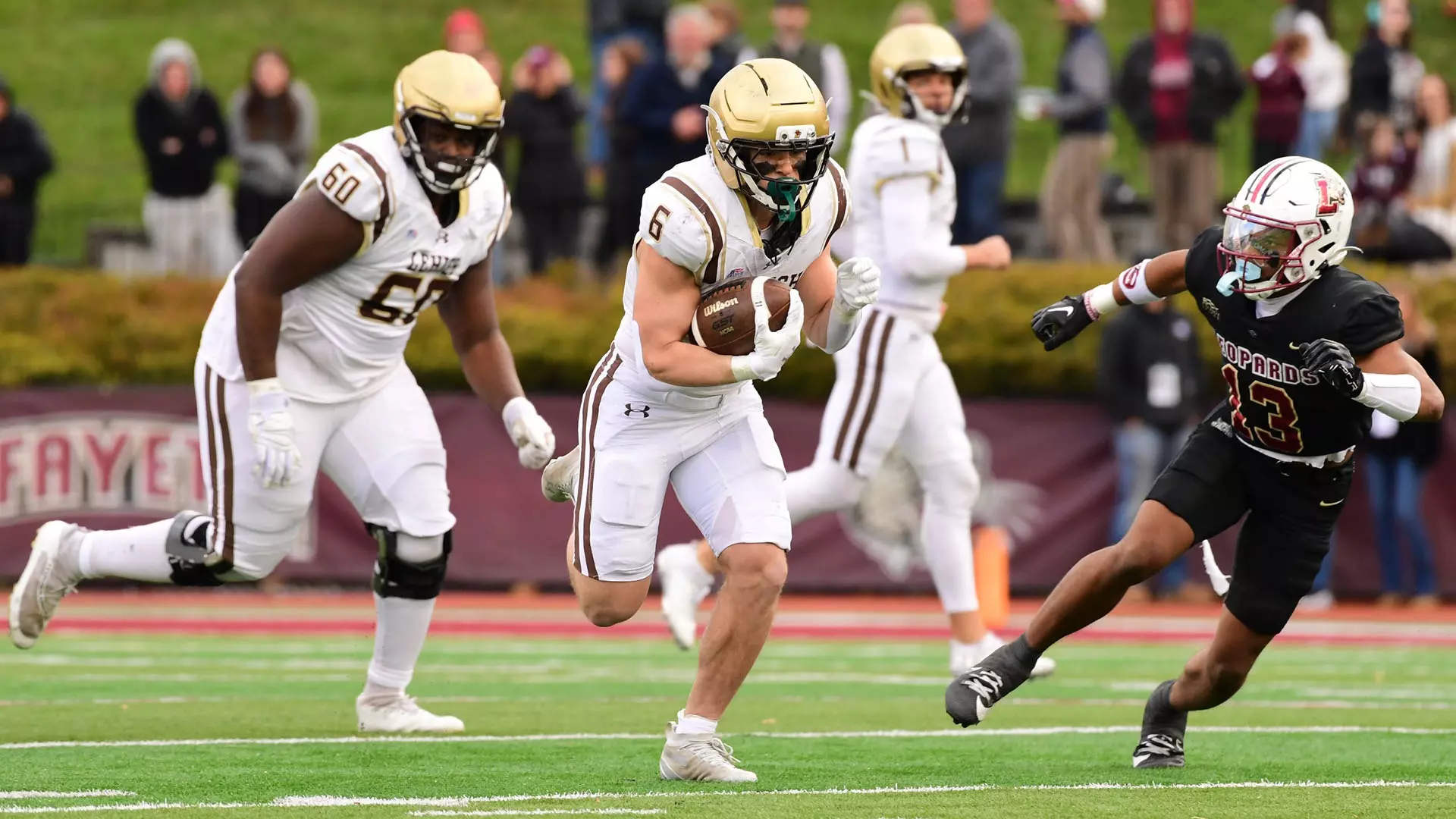
Echoes of 1988
The 162nd meeting of the Rivalry, like the 124th in 1988, didn’t have a league title on the line. The Mountain Hawks, entering the game at 9-2, had already clinched at least a share of this year’s Patriot League title with a 21-14 win over Richmond. Like Lafayette in 1988, however, Lehigh was still playing for an outright championship. A loss could have left the door open for Holy Cross to share the title.
Lehigh also had something Lafayette didn’t have in 1988: a guaranteed postseason game the following week. By winning even a share of the Patriot League title, the Mountain Hawks had secured the league’s automatic bid to the FCS Playoffs.
The 4-6 Leopards had struggled through a difficult season. After winning their home opener 13-9 over Marist, they endured a three-game losing streak that threatened to derail their season.
“You look at that three-game stretch and we had an overtime loss at Columbia and games against Holy Cross and Richmond where we lost by a score,” Lafayette head coach John Troxell said. “Those are games that can change your season if you win them. We were 1-4 at one point and the kids could have folded the tent, but the kids kept fighting and got us back to 4-6.
“I am proud of what the kids did to get us back to this point because they kept fighting, fighting and fighting. They didn’t quit. A win in this game can erase a lot of the heartache we’ve had through the course of the year.”
The Rivalry is always a major event in the Lehigh Valley, but Lafayette, celebrating the bicentennial of its founding, pulled out all the stops. The Leopards hosted the 200-member Easton High School band to provide additional atmosphere and wore special 200th-anniversary jerseys for the occasion.
“We know we have to play with composure and with a will to hunt,” Lafayette OL Sean Wilson said in the run-up to the game. “Each time we’re out there on the field for eight seconds each play, we have to be ready because we’re going to war on Saturday.”
In 1988, Lehigh and Lafayette entered the game with the No. 1 and No. 2 ranked offenses in all of I-AA. There was little mystery about what kind of afternoon might unfold. Points were expected.
This time around in 2026, the circumstances were different. Both teams had true freshmen at quarterback, and while there was plenty of offensive talent on both sides, nobody could reasonably have predicted another 97-point afternoon.
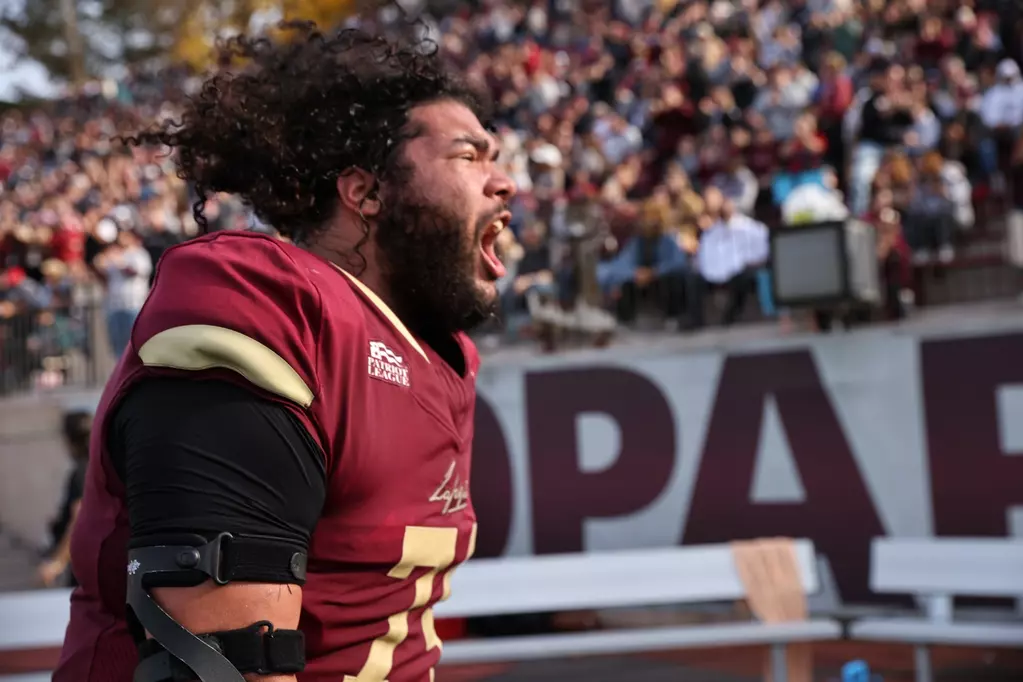
The 162nd Rivalry Gets Underway
Perhaps the signs of a high-scoring afternoon were there from the opening kickoff.
Just as it had in 1988, Lafayette opened the scoring with a touchdown drive. The 1988 Leopards needed nine plays to cover 60 yards, finishing with an 11-yard pass from Frank Baur to WR Maurice Caldwell. This time, the Leopards covered 73 yards in eight plays, with RB Jakyre Henley providing two big runs before QB Jason Penza finished the drive with a four-yard touchdown run.
Lehigh answered with a long drive of its own, but had to settle for a 20-yard field goal by PK Connor Poole. The scoring, as it turned out, was only getting started.
In ’88, nine touchdowns were scored in the first half, with one field goal and no punts. In ’26, Lafayette added a field goal on its next possession., a 36 yard field goal from PK Jack Simonetta, and then Lafayette’s defense would force a three-and-out, DE Sean Curtis sacking Coan to cause Connor Poole to come out and punt. You could feel the emotion rising in the crowd as Poole lofted a 36-yard punt. The Easton High School band belted out fight music, and WR Nick Bierman returned the kick 15 yards into Lehigh territory.
That would be the last punt of the half as the Leopards started to put the pressure on the Mountain Hawks and the energy of The Rivalry began to swing Lafayette’s way. The Leopards, to their credit, entered the game with a lot of energy and seemed to feed off of it on every play, while Lehigh, notoriously slow starters this season, were a bit more businesslike in their approach.
You could feel the pressure rise on Lehigh as the Leopards drove to the Lehigh 28-yard line, threatening to build a substantial lead. But the Mountain Hawk defense rose up. DT Jadin Nelson stopped Jordan well short of the sticks on third down, stalling the Leopard drive. Then it was the Lehigh Marching 97’s turn to shine, the horns swelling to punctuate the big stop. PK Jack Simonetta, however, responded with a 45-yard field goal that cleared the crossbar with ease.
So far, so normal. With 9:37 left in the first half, Lafayette led 13-3, and it seemed like this edition of the Rivalry would be of the more conventional variety – the “war” Sean Wilson mentioned earlier in the week.
Then things… started to get crazy.
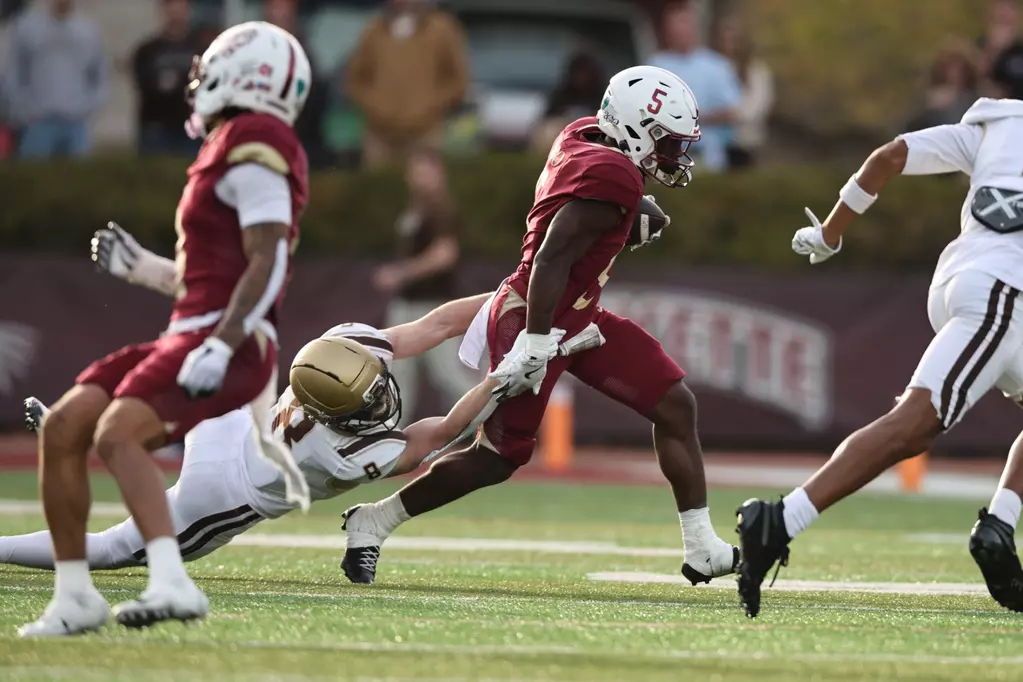
Overdrive
Down by 10 points, the Mountain Hawks get started with a big play. Rolling out right, Coan threw across his body under pressure to WR Bryce Werner deep downfield for a 53-yard strike, bringing the Lehigh stands to life. Three plays later, Coan would throw an easy pass to WR Nick Palumbo to cut Lafayette’s lead to 13-10.
The Leopards, who had scored on every possession to that point, drove the length of the field and answered with another touchdown. this one a two yard surge by RB Jakyre Henley. The ten point deficit was the second time the Mountain Hawks were down by double digits on the afternoon, 20-10.
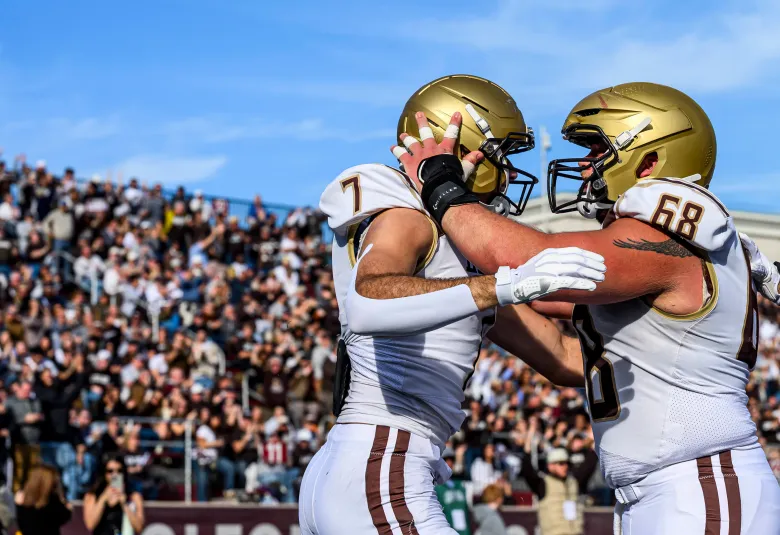
Then, another explosive play. WR Jamaire Harden returned the opening kickoff 79 yards, zigzagging back and forth to grab a hunk of momentum back and set up the Mountain Hawks for another score.
“My team, they told me we needed to play, man,” Harden told me after teh game. “So I had to go out there and get us going, man. And you see what the results came out to be.”
The return gave a short field for the offense to work with. After a hurdling Luke Yoder 20 yard run set up first and goal at the 2, and after Lafayette’s defense stiffened, QB Patrick Coan took a designed run on 3rd and 2 into the end zone for a much-needed touchdown, 20-17. He made a shoulder fake into the line, then when the linebacker committed, he went outside behind a stupendous block by TE Giacomo Macce and pushed into the end zone. It looked like the move of a senior quarterback, not a freshman in his first-ever Rivalry start.
Lafayette wasn’t finished answering, though. On the Leopards’ next possession, QB Eddie Jordan, also looking more like a four year starter than a first year student, found WR Nick Bierman for a 53-yard touchdown, a one-play strike that took just seconds and brought back memories of 1988. In that game, Frank Baur connected with WR Phil Ng for a 59-yard touchdown on a one-play, 14-second drive. The circumstances weren’t quite identical, but the effect was familiar: just when Lehigh seemed to have seized some momentum, Lafayette struck with a long touchdown pass of its own.
It was Lafayette’s final touchdown of the half that really made the game start to feel like the shootout back in 1988. Explosive plays were beginning to reveal themselves: Harden’s kickoff return, Yoder’s burst down to the two-yard line, and Jordan’s long pass to Bierman. The echoes of my freshman year were becoming harder to ignore.
Little did I know just how many more were still to come.
A Familiar First Half
The second half shared the energy of 1988 — and the tension.
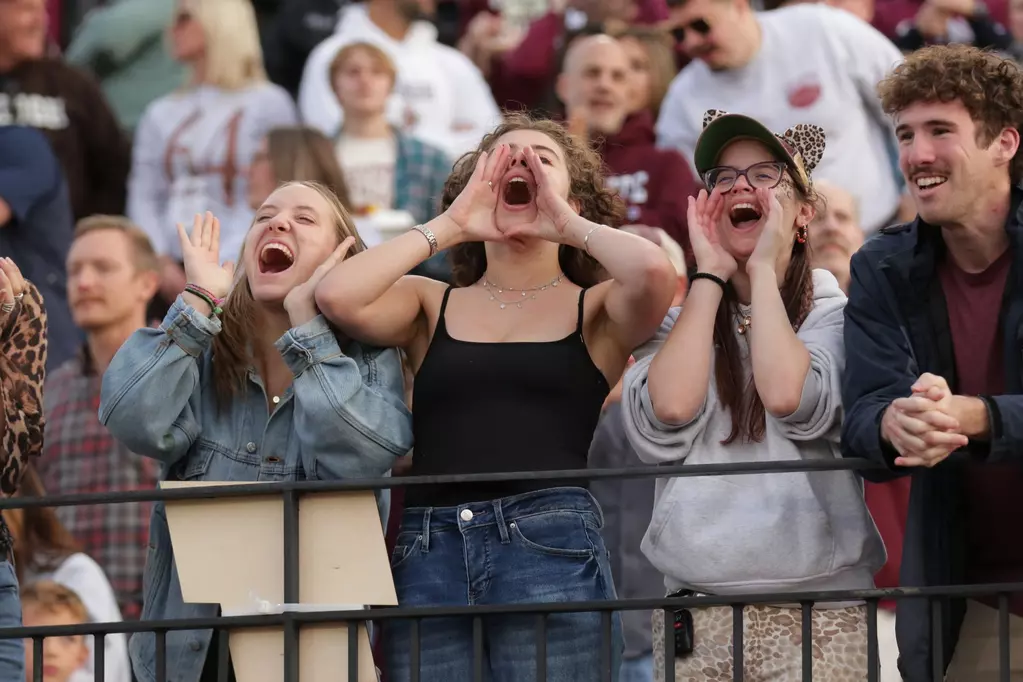
Lehigh fans spent the final seconds of the first half coiled and uneasy. An outright Patriot League championship, and the valuable home playoff game that would come with it, suddenly seemed less certain. Bierman’s touchdown grab prompted the 5-foot-9 sophomore to howl at the moon in the end zone, sending the Lafayette side of Fisher Stadium into a frenzy. The Leopards had scored on all five of their first-half possessions, and with that one explosive play, they had restored a double-digit lead just before heading to the locker room.
The touchdown came so soon after Coan had cut the deficit to three that it seemed to give Lafayette’s fans an extra jolt. They rose to their feet as Bierman rang the touchdown bell behind the home sideline, celebrating a first half in which the Leopards had done just about everything right.
“Lehigh is going into the locker room in some trouble here,” Steve Degler accurately noted on the Service Electric One TV broadcast, just before the elated Lafayette fans gave their team a standing ovation.
“Right now, we gotta figure out what we can do,” Rich Nagy said, visibly frustrated, to sideline reporter Mike Yadush on the broadcast. “Because right now we’re giving up too many explosive plays. We gotta get that straight as a staff, and just go out and make some plays. We gotta get the ball back to the offense. That’s the biggest thing.”
Both bands played at halftime. The Marching 97 put on a shorter-than-normal, but no less passionate, show for the Lehigh stands, while the Easton High School band performed a Lafayette-themed tribute, bringing its trademark big sound to the home side of the field. With the Marching 97 having had fewer opportunities to play during the afternoon, the halftime show offered an interesting contrast: Easton’s band could let loose, much like the Lafayette fans, while Lehigh’s musicians, like the Mountain Hawks themselves, were still waiting for their moment.
Looking over the halftime statistics, there were definitely echoes of 1988 in the battle of the freshman quarterbacks. Back then, Jim Harris and Frank Baur combined for 44 completions on 55 attempts for 681 passing yards in the first half, accounting for much of the afternoon’s scoring. The 2026 freshman signal-callers didn’t come close to matching that yardage, but they were even more efficient, missing on just one pass between them. Together, they completed 18 of 19 attempts for 346 yards. For good measure, Lafayette QB Jason Penza added a rushing touchdown of his own to the tally.
The Mountain Hawks had been in this position before. Luke Yoder explained afterward that the halftime message was familiar.
“For the past four weeks we were down at halftime,” he said after the game, “so same message goes, we’ve been in these situations before, the offense is getting the ball coming out at halftime, so score on that drive, and get things going then in the second half.”
Rivalry Chaos
Whatever was said in the Lehigh locker room, there’s no denying that it was effective.
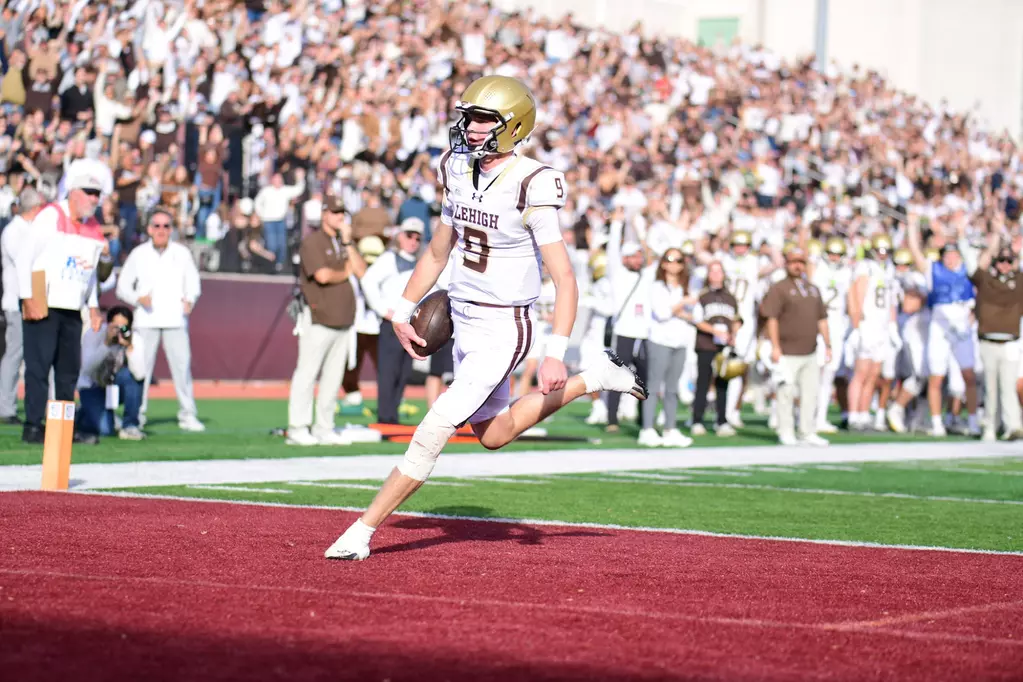
It took Lehigh all of two plays to score. Coan would find WR Matt D’Avino for a 50-yard strike, and Coan would take it in for a run on the very next play, cutting the deficit to three once again. Coan’s second rushing touchdown was an echo of his first, interestingly — faking a run into the pile, then making a move outside, this time for 20 yards.
There was something familiar about watching Lehigh’s freshman quarterback take off and run. In 1988, I was watching Lafayette’s Frank Baur, a 6-foot-4, 220-pound senior, make plays with his legs as well as his arm. In that Rivalry game, he scored on a fourth-down bootleg in the third quarter to give the Leopards their first lead of the afternoon. Coan, also 6-foot-4, is a much leaner 190 pounds, and still has plenty of physical development ahead of him. But the similarities between the two quarterbacks were hard to miss.
But before that comparison could sink in, Lafayette responded with a two-play drive of its own.
Jordan threw a short screen pass to RB Jakyre Henley, who had some great blocking in front of him. Henley pushed DB T.J. Hill out of the way, then raced down the right sideline, barely keeping his feet in bounds for a 77-yard score. The horn went off, bringing the Lafayette fans to their feet again. Simonetta added his fourth extra point, increasing his scoring total and making it 34-24 Lafayette.
For the fourth time in this shootout, Lehigh was down by double digits. And in four plays to start the second half – similar to 1988 – the Mountain Hawks and Leopards were trading big plays for big points. Both teams were trying to ride their big plays into the momentum to change the game – and both offenses were delivering touchdowns.
In the past, I’ve seen both Lehigh and Lafayette defenses in The Rivalry wilt when they face a barrage of points. In a game with this much history and emotion, sustaining the energy necessary to withstand an offensive onslaught is no easy task.
All year, though, coach Nagy has emphasized Lehigh’s ability to have a short memory, especially on defense. In a tight 24-20 win against Dartmouth earlier in the season, he said “I don’t know if it’s good to have a game like this, but it was good to be tested. Today we overcame some situations and, in the end, we were able to make plays. It’s a testament to the players and their belief in our culture and what we do. It was a belief in each other and in the coaching staff.”
You could see that belief in action in the Mountain Hawks after a 5 play, 75 yard scoring drive by the Lehigh offense, set up by an electrifying 50-yard run by Yoder, and ending on a eight-yard run by RB Aaron Crossley – his first of the season, making the score 34-31 Leopards. (Meanwhile, PK Connor Poole was stacking up points — the first-half field goal, and now his fourth extra point.)
Lehigh’s defense came back out as it it were 0-0, first tripping up Penza for a short gain – and then making one of the biggest plays of the game.
DE Lucas Manderbach evaded the block of the left tackle, and got his hand up to hit Jordan’s bicep, forcing a fumble just before his arm was to go forward.
The ball dribbled loose, and LB Josh Lenart leaned down, and cradled the ball for dear life. He holds on. Lehigh ball, deep in Lafayette territory, and the Lehigh fans explode with joy in the visiting stands.
When Lehigh came from behind to beat Richmond the previous week, Nagy said of his defense, “They never gave up. We got down there, but they never dropped their heads. They just kept playing, and then when you do that, good things can happen.”
A week later, that’s exactly what happened with the forced turnover. After the game, Nagy acknowledged that the defense hadn’t played to its own expectations, but he also recognized that his players had made stops when they needed them. And when the fumble recovery came up specifically, he immediately agreed that it was a huge moment.
With a first-and-10 at the Lafayette 11, it was the Leopards’ defense’s turn to make a stand. Lehigh tried to lean on its vaunted rushing attack to take the lead, but a host of Lafayette tacklers, undoubtedly buoyed by the home crowd, gang-tackled Luke Yoder short of the goal line.
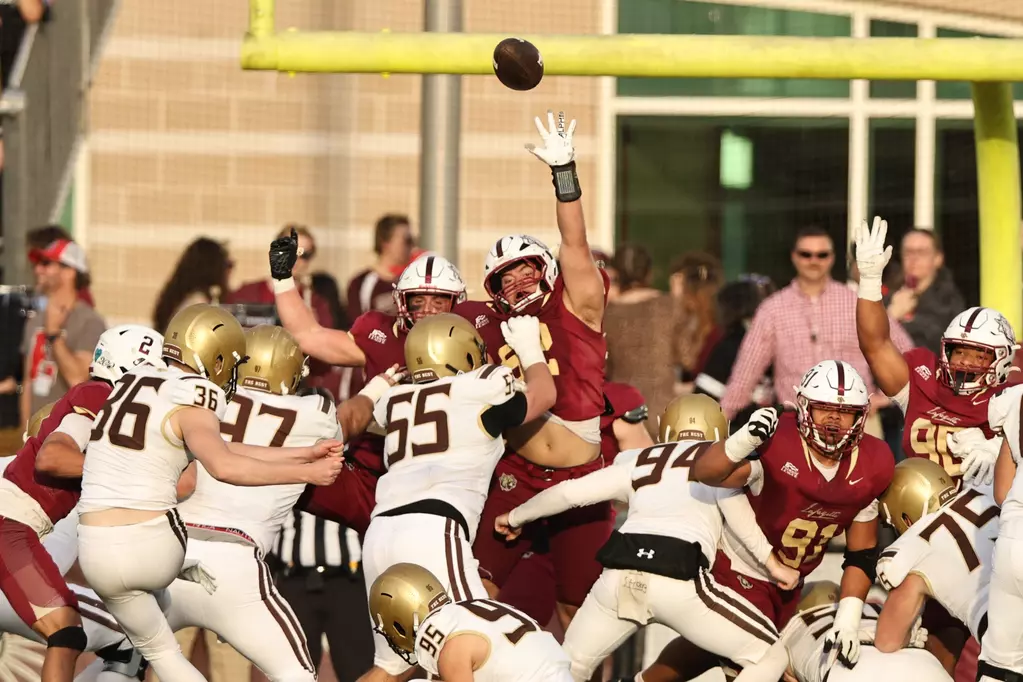
Facing fourth-and-less-than-one at the 2, Nagy had the option to go for it. Instead, he leaned on Connor Poole to make sure the Mountain Hawks came away with points. Poole’s chip-shot 19-yard field goal tied the game at 34.
“I just didn’t want to go chasing and put us behind situations,” Nagy told me afterwards. “If we didn’t get it, then it could have been real detrimental later.”
It was a decision rooted in the importance of staying within striking distance and taking points when they were available. Poole was now responsible for 10 of Lehigh’s points: four extra points and two field goals.
Serve and Volley
In 1988, Lafayette head coach Bill Russo described his high-scoring shootout as a tennis match.
Once the 2026 game was tied at 34, it too became a serve-and-volley affair, with both sets of fans watching the offenses repeatedly drive down the field in search of an advantage.
On the Leopards’ next drive, Lehigh’s Jadin Nelson and Preston Davis combined to stop a Leopard drive, forcing Lafayette’s first punt of the game.
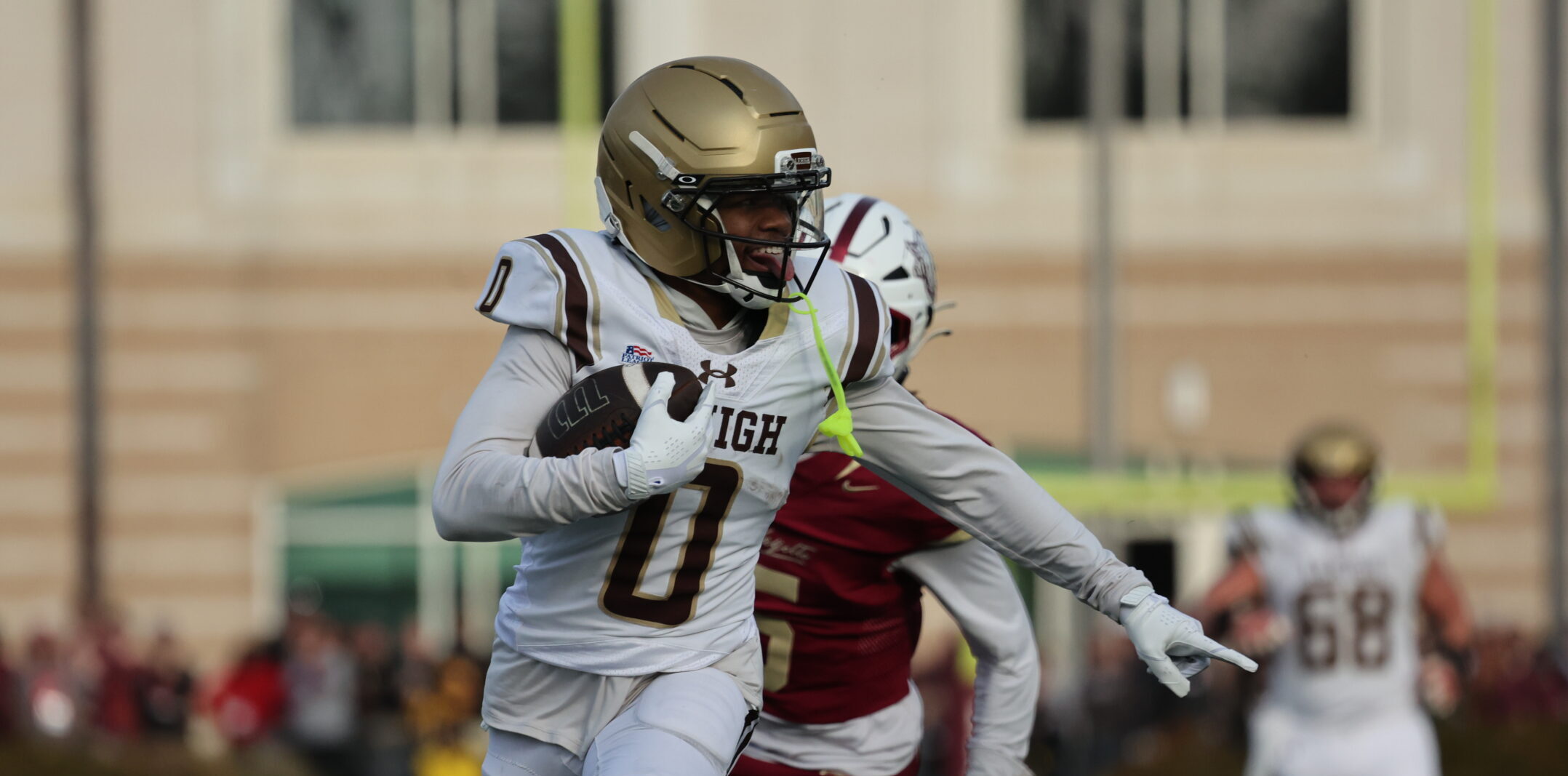
Coan then drove the Lehigh offense to the Lehigh 48-yard line, and on first down, connected on a bubble screen to the left to WR Jamaire Harden. Harden got an initial block from WR Bryce Werner, then took off toward the middle of the field, forcing several Leopards to miss tackles. After reaching the right side, RB Aidan Mayfield pushed one blocker out of the way. Harden turned the corner, and Mayfield moved forward to deliver a second, sealing block that helped spring Harden for the touchdown — and Lehigh’s first lead.
After the game, Harden credited Mayfield for helping turn the short pass into a 51-yard touchdown that involved maybe twice as much yardage including going sideline to sideline. “I just got the ball, seen it open, and I see my running back, Mayfield. He hustled, got the block for me, and I got all the way around and got in the end zone.”
Lehigh serves, Lafayette volleys.
After an exchange of punts, Lafayette needed just five plays and two minutes to answer. On third-and-seven, QB Eddie Jordan handed the ball to RB Malachai Gamble, who found a huge hole and raced 16 yards for the touchdown.
The Leopards had a chance to tie the game, but DT Andrew Sharga surged past the long snapper and got his hands up to block the extra point. That left Lehigh with a 41-40 lead and 11:24 remaining.
Lafayette serves, Lehigh volleys.
The Mountain Hawks responded with an 11-play, 75-yard drive that consumed nearly six minutes. It was a drive built around third-down conversions. Facing third-and-10 on the opening set of downs, Coan found WR Anthony Feaster for 17 yards. After a pair of short runs, RB Aaron Crossley picked up seven yards on third-and-seven to keep the drive alive, getting flipped head over heels but still managing to get the critical first down.
RB Luke Yoder then ripped off consecutive runs of 11 and 20 yards, moving Lehigh deep into Lafayette territory. After Coan added four yards on a keeper, the Mountain Hawks faced another third down, this time from the 13. Coan found TE Aiden Schomp in the end zone for a 13-yard touchdown, finishing a drive in which Lehigh converted all three of its third-down opportunities.
With 5:35 remaining, Lehigh had extended its lead to 48-40. Schomp headed to the sideline, pumping up the Lehigh crowd, before taking a seat on the bench, visibly exhausted. It was an unnaturally warm afternoon, and both Leopards and Mountain Hawks had been cramping at times. As the game wore on, the physical toll of the afternoon was becoming harder to ignore.

Lehigh serves, Lafayette volleys — tie game.
With 5:35 to play, two exhausted teams made two big stops to force punts. The Leopards punted to the Lehigh 26, and the Mountain Hawks ran the ball to force the Leopards to burn timeouts. Two runs, two timeouts, and Anthony Feaster tried to make a circus catch to get a spectacular first down to ratchet up the pressure but it fell incomplete. The Leopards would get the ball back with 2:52 to play.
Lafayette would have one final opportunity to keep its season alive. Nick Bierman’s 10-yard punt return gave the Leopards the ball at their own 32, and Eddie Jordan immediately went to work. He found WR Carson Persing for 13 yards, then connected with WR Mason Kuehner for a 25-yard gain that moved the ball to the Lehigh 30. Kuehner added another 12-yard reception on the next play, moving the chains again.
Lafayette was in business, but an unsportsmanlike conduct penalty pushed the Leopards back, leaving them facing fourth-and-18. With the game on the line, Jordan dropped back, scrambled, and found Persing leaping for a 21-yard touchdown over the middle. The Lafayette crowd, seemingly willing its exhausted offense forward, erupted. Suddenly, the Leopards were within two points, trailing just 48-46.
They weren’t finished. Lafayette spread the offense wide for the two-point attempt, leaving Jordan with only four blockers in front of him. The freshman scrambled to his right, drawing the defense with him, then appeared to leave his feet as he delivered the ball to a wide-open TE Ethan Hosak for the conversion. Just like that, the game was tied at 48, with 34 seconds remaining. Hosak put a finger to his helmet and shushed the stunned Lehigh crowd, to the delight of the home fans.
Lehigh had one last chance to avoid overtime. But the Mountain Hawks couldn’t get anything going. And then came a huge play that shouldn’t be overlooked in the story of how regulation ended.
A sack of Coan and forced fumble by LB Callahan Blair brought back memories of Jordan’s earlier fumble, which Lehigh had recovered. This time, though, WR Nick Palumbo alertly raced back and recovered the loose ball in front of about five Lafayette defenders. He secured it at the 38-yard line with 10 seconds remaining. Had the Leopards recovered, they would have had a legitimate opportunity to get into field-goal range, especially with a timeout still available.
Thanks to Palumbo, overtime loomed. But the final outcome was still far from certain.
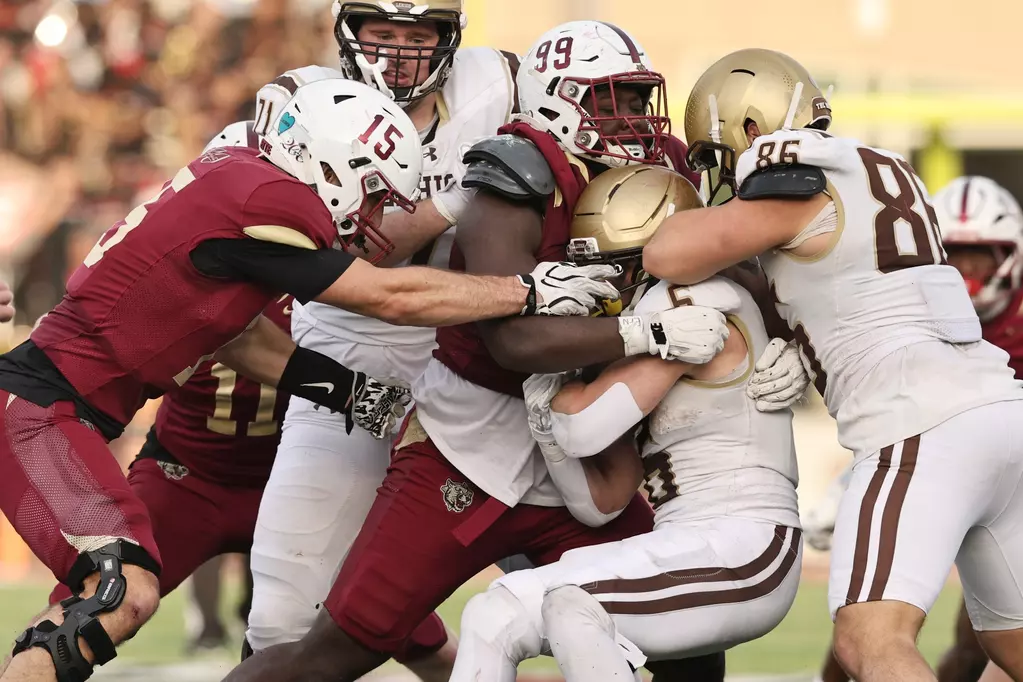
Last Team Standing
Sometimes football games come down to small things and individual plays. A fourth-down touchdown grab here, a successful two-point conversion there. A turnover here, a critical fumble recovery there. In this 162nd meeting of the Rivalry, 96 combined points in regulation weren’t enough to decide the outcome. After all that, it would come down to two possessions in overtime — and which team could make one more play.
The 1988 contest did not go to overtime. Back then, a game finishing in a tie was possible. In that game, had Lehigh found a way to score a miracle touchdown with 34 seconds left, head coach Hank Small would have been faced with a very, very tough decision.
In this year’s shootout, it took a lot of those small things to get to this point. Rather than go for it on fourth-and-less-than-one, Rich Nagy elected to send Connor Poole out for a chip-shot field goal to tie the game at 34. It took Andrew Sharga’s blocked extra point to keep the score 41-40. It was Aiden Schomp‘s touchdown grab — his only reception of the game — to go up by 7, and Connor Poole’s extra point to make it an eight-point game. That took the decision out of Lafayette head coach John Troxell’s hands at the end of the game — Lafayette was forced to go for the touchdown and the two-point conversion to tie, not win.
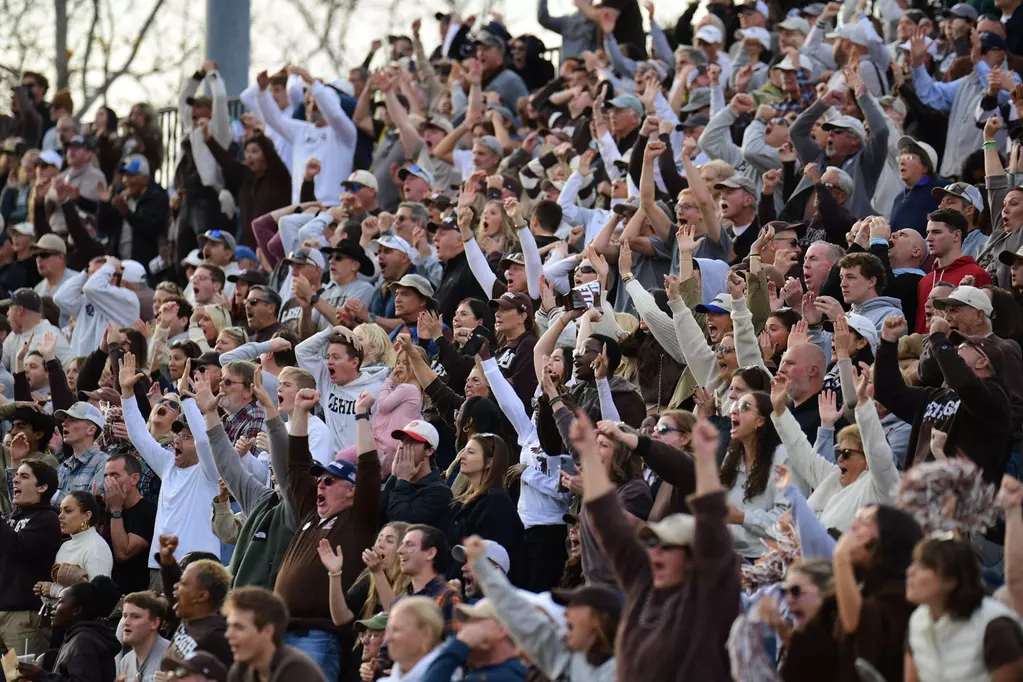
In that sense, the overtime truly did echo that 1988 shootout. It too was a game of possibilities, decisions, and the razor-thin margins between winning, losing, and even tying — speculation that never really goes away, even 38 years and 2 days later. What if Hank Small didn’t try that fake punt in the fourth quarter? What if Lafayette freshman RB Tom Costello played on a hot day in November, like this one, instead of a frigid afternoon in 1988? Would he have cramped up at a critical moment?
In 1988, Lehigh scored with 2:50 remaining to pull within 52-45, then attempted an onside kick that failed to travel the required 10 yards. The Mountain Hawks’ defense nearly got the ball back, but, as the Brown and White account recalled, the official’s spot on James Adams’ run gave Lafayette a first down by a couple of inches. The Leopards then ran out the clock.
What if that spot had been just a few inches the other way? What if Lehigh had gotten the ball back and scored again, making it 52-51 Lafayette with 34 seconds left? Would Small have kicked the extra point to tie the game, or gone for two and the win?

In the end, those are the questions of offseason speculation that make the Rivalry so immersive. They make following Lehigh and Lafayette unique. Once it’s in your bloodstream, it kind of stays there.
If I looked hard enough, I could look over at the Lehigh side, and see a young freshman, cold, surrounded by his friends, looking to souvenirs on the field. Eying the prize, an end zone pylon,and eying others around him, wondering which fists to avoid. You could almost see the Rivalry taking hold, becoming something that would stay with him long after that afternoon.
But here I was, in the press box, watching the 2026 Lehigh Mountain Hawks head to overtime. The fans on the other side were all standing. So much was at stake. More than just a win over their Rivals.
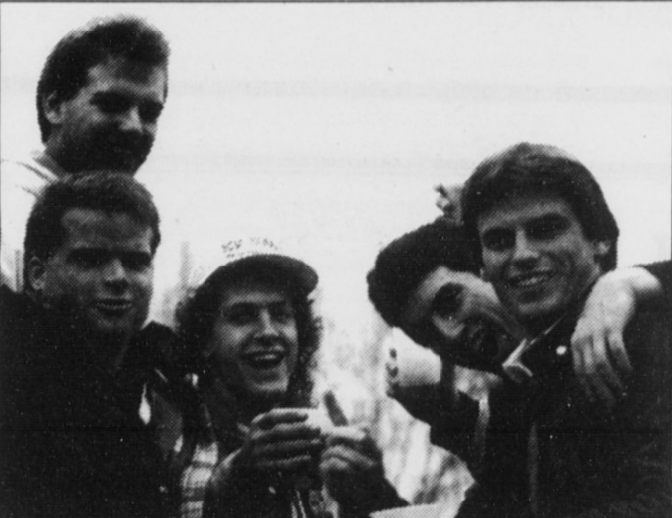
All those possibilities led back to this moment. Two teams, two possessions, two attempts to score.
Lehigh won the toss and elected to play defense first, giving the Leopards the first opportunity to take the lead in overtime. Starting at the Lehigh 25, the first pass, a trick play with RB Jakyre Henley looking for Mason Kuehner, fell incomplete. Jordan’s next attempt was broken up by Lehigh DB Ignatious Williams. Facing third-and-10, Jordan found Henley for four yards, but it left Lafayette with fourth-and-six.
Jack Simonetta came on to attempt a 38-yard field goal. The kick sailed wide. He grabbed his helmet.
The agony of it. He had been perfect in extra points all year, until Sharga’s blocked extra point earlier, and he only missed one inconsequential field goal all year.
But Lehigh now had its chance. One possession. One score.
“As a coach, you go through so many emotions during the course of the day,” Nagy told mme after the game. “And if I didn’t, I shouldn’t be in it.”
Luke Yoder opened with a 10-yard run, moving the Mountain Hawks to the Lafayette 15. But the Leopards’ defense stiffened, stopping Yoder for no gain, then a one-yard loss, then four yards. Lafayette fought. Every fan was up in their seats. All 13,000 plus fans were about to burst, one way or another.
Connor Poole came onto the field for a 30-yard field goal attempt. After everything that had happened over the previous three and a half hours, the game came down to his kick.
Poole lined up for the kick. Long snapper Ridgely Ritter lined up the ball. Holder John Zipf got in his familiar spot. Snap. Hold. Kick… and Connor Poole hit the ground. A Lafayette player came in from the right and knocked him to the ground, facing him away from the golaposts. He didn’t see the ball go through the uprights.
He had heard the crowd erupt and realized what had happened. “I was like, oh, yeah, I definitely went in,” he told me afterwards. The kick was indeed good. Lehigh had outlasted Lafayette, 51-48.
The celebration was immediate. Poole got up, strutted to midfield, and was mobbed by his teammates, and the Lehigh sideline emptied onto the field. After a game that had featured so many twists, turns, and moments when the outcome seemed to be slipping away, the Mountain Hawks had made the final play.
For Poole, this was the opportunity he’d been dreaming of.
“I’ve just been waiting for that opportunity so much that when it came, like, it wasn’t a surprise,” he told me.
He explained that he’d learned a technique a few years earlier to help in the pressure of a game-winning situation like this. “You look at the other end because it looks so far, and when you turn around, it looks very close.”
He was also quick to credit the people who helped make the kick possible. “I gotta thank the guys who gave me that opportunity to do it,” he said. “Because if there’s not a good snap and hold, there’s no chance.”
After the game, a postgame melee of a different sort happened than the violent chaos of a 1988 Lehigh/Lafayette aftermath.
Fans, players and coaches stormed the field to celebrate together, with almost as much relief as joy. The end-zone pylon I’d once managed to get my hands on, long since lost, was a distant memory. The vision of Connor Poole holding up the “Lehigh” on his jersey toward the press box, three fingers raised for three rings in three years. (Four years ago, it was Lafayette who celebrated a Patriot League title on Lehigh’s home field.)
“Guys are there for a college experience,” Nagy said of his team after the game. “Guys are there to play football at a high level. And they get a chance to do both and they get to form some great relationships that are going to last a lifetime.”
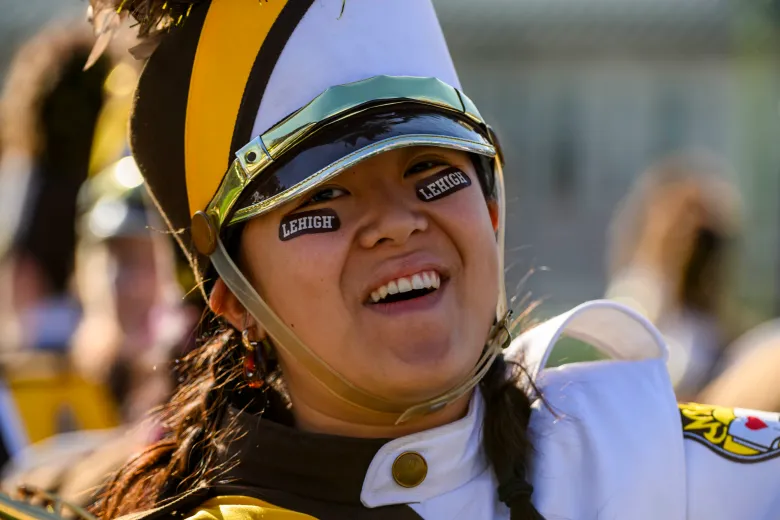
Not to be forgotten, the spent Lafayette players also lingered, some of them in the final Lehigh/Lafayette games of their careers. The suddenness of an overtime loss, and how quickly it can all change, lingered. Some stayed to be with family and friends, others went into Bourger Varsity Field House to their locker room. I cannot emphasize enough how hard they played, and how much they left on the field.
“For the year we had, the kids never quit,” Lafayette coach John Troxell said. “It was a classic. We missed a kick; they made a kick and that’s how it goes sometimes. I feel terrible for our kids. They fought all the way to the end. The effort they put into this week was outstanding and it showed today. I am proud of them.”
This edition of the Rivalry was so close, and the two teams played at such a high level, that you can’t help but go through the “What if” scenarios. So little separated them.
“We had a young group and this is just a tough loss that’s hard to put into words,” Troxell said. “I feel bad for our seniors, but I feel good for our younger guys because this is something to build on. We’ve got a good group coming back if they all stay. Hopefully they will. My next task is to try to make sure we keep them here.”
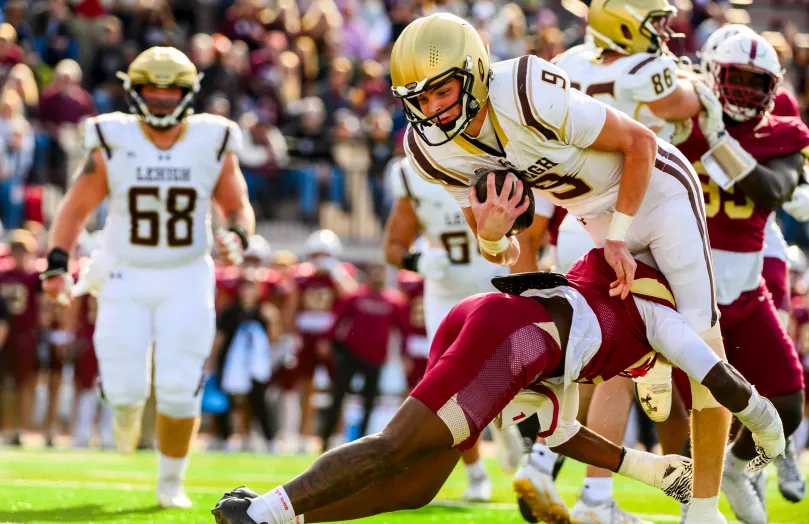
Somewhere after the game, QB Patrick Coan was announced as the MVP of the 162nd meeting of the Rivalry. In a way, his winning of the award made sense, being a critical part of Lehigh’s five touchdowns. His two rushing touchdowns, bringing back memories of Lafayette’s Frank Baur in 1988, will be woven into Rivalry history, along with his brutally efficient 13-for-16 passing performance for 258 yards and three passing touchdowns.
“He’s a worker, man,” Harden said of his offensive teammate. “Since he came in, man, he’s been under Hayden’s right wing trying to get better each and every day. And his moment came…”
His individual effort was extraordinary for sure, but it felt like the overall win came from so many individual efforts of the whole team. Coan humbly expressed that in his postgame comments in Keith Groller’s recap of the game in the Morning Call.
“It feels great; it was a great game,” Coan said. “With an offense likes ours, it makes my job a lot easier. It was great stuff out there today. Also, how our defense also gave us the ball in key moments was great. I don’t know if I expected this kind of game. I was just ready to play football today. We were all ready just to play football.”
The celebration on the field was extensive, and it went on for a long time. The Marching 97 played in the stands, then moved onto the field, forming a semicircle. They powered through all the music they’d practiced, some of them playing their final Rivalry game, as thrilled players, fans, coaches and friends wandered around the field. After a tense afternoon of so much uncertainty, the certainty of the Patriot League outright title — and the convincing final argument before the FCS Playoffs — hung in the air like the notes of music.
Lehigh was the last team standing. No matter what happens in the FCS Playoffs, the Mountain Hawks earned this historic Rivalry win.
Score by Quarter
| Team | 1 | 2 | 3 | 4 | OT | Final |
|---|---|---|---|---|---|---|
| Lafayette | 7 | 20 | 7 | 14 | 0 | 48 |
| Lehigh | 3 | 14 | 24 | 7 | 3 | 51 |
Game Details
Lafayette 4-7 (3-5 PL)
Statistical Leaders
Passing
Lehigh
Patrick Coan: 13-of-16, 258 yards, 3 TD, 0 INT
Lafayette
Eddie Jordan: 21-of-24, 347 yards, 3 TD, 0 INT
Rushing
Lehigh
Luke Yoder: 29 carries, 160 yards
Patrick Coan: 9 carries, 35 yards, 2 TD
Lafayette
Jakyre Henley: 17 carries, 97 yards, 1 TD
Receiving
Lehigh
Bryce Werner: 3 catches, 69 yards
Jamaire Harden: 2 catches, 66 yards, 1 TD
Lafayette
Mason Kuehner: 7 catches, 115 yards
Nick Bierman: 4 catches, 82 yards, 1 TD
Defense
Lehigh
Mick McKee, T.J. Hill, William Parton and Josh Lenart: 8 tackles each
Lafayette
Dhonte Jackson: 8 tackles
Beckham Dee: 7 tackles
Interceptions
Lehigh
No interceptions
Lafayette
No interceptions
Sacks
Lehigh
Lucas Manderbach: 1 sack, 6 yards
Lafayette
Callahan Blair: 1 sack, 8 yards
Sean Curtis: 1 sack, 2 yards
Scoring Summary
| Qtr. | Time | Team | Scoring Play | LAF | LEH |
|---|---|---|---|---|---|
| 1 | 11:11 | LAF | Jason Penza 4-yard run (Jack Simonetta kick) | 7 | 0 |
| 1 | 4:05 | LEH | Connor Poole 20-yard field goal | 7 | 3 |
| 2 | 14:51 | LAF | Jack Simonetta 36-yard field goal | 10 | 3 |
| 2 | 9:37 | LAF | Jack Simonetta 45-yard field goal | 13 | 3 |
| 2 | 7:33 | LEH | Nick Palumbo 5-yard pass from Patrick Coan (Poole kick) | 13 | 10 |
| 2 | 2:50 | LAF | Jakyre Henley 2-yard run (Simonetta kick) | 20 | 10 |
| 2 | 1:05 | LEH | Patrick Coan 2-yard run (Poole kick) | 20 | 17 |
| 2 | 0:14 | LAF | Nick Bierman 53-yard pass from Eddie Jordan (Simonetta kick) | 27 | 17 |
| 3 | 14:15 | LEH | Patrick Coan 19-yard run (Poole kick) | 27 | 24 |
| 3 | 13:32 | LAF | Jakyre Henley 77-yard pass from Eddie Jordan (Simonetta kick) | 34 | 24 |
| 3 | 10:57 | LEH | Aaron Crossley 8-yard run (Poole kick) | 34 | 31 |
| 3 | 7:58 | LEH | Connor Poole 19-yard field goal | 34 | 34 |
| 3 | 2:36 | LEH | Jamaire Harden 49-yard pass from Patrick Coan (Poole kick) | 34 | 41 |
| 4 | 11:24 | LAF | Malachi Gamble 16-yard run (extra point blocked by Andrew Sharga) | 40 | 41 |
| 4 | 5:35 | LEH | Aiden Schomp 13-yard pass from Patrick Coan (Poole kick) | 40 | 48 |
| 4 | 0:34 | LAF | Carson Persing 21-yard pass from Eddie Jordan (Ethan Hosak two-point conversion pass) | 48 | 48 |
| OT | — | LEH | Connor Poole 30-yard field goal | 48 | 51 |

Chuck has been writing about Lehigh football since the dawn of the internet, or perhaps it only seems like it. He’s executive editor of the College Sports Journal and has also written a book, The Rivalry: How Two Schools Started the Most Played College Football Series.
Reach him at: this email or click below:
