David Coulson: Once-Proud FCS Champions And Rivals Meet In Juiceless Birmingham Bowl That Demonstrates Precarious Place of Non-Power Teams
BOONE, N.C. — So this is how the 2025 college football season ends for Appalachian State. With two one-time FCS powerhouses, the Mountaineers and Georgia Southern playing in a meaningless bowl game in Birmingham, Alabama.
Now residing in the vast wasteland of the Football Bowl Subdivision’s outcast Group of Six, these teams with nine combined national championships at the FCS level are now reduced to this.
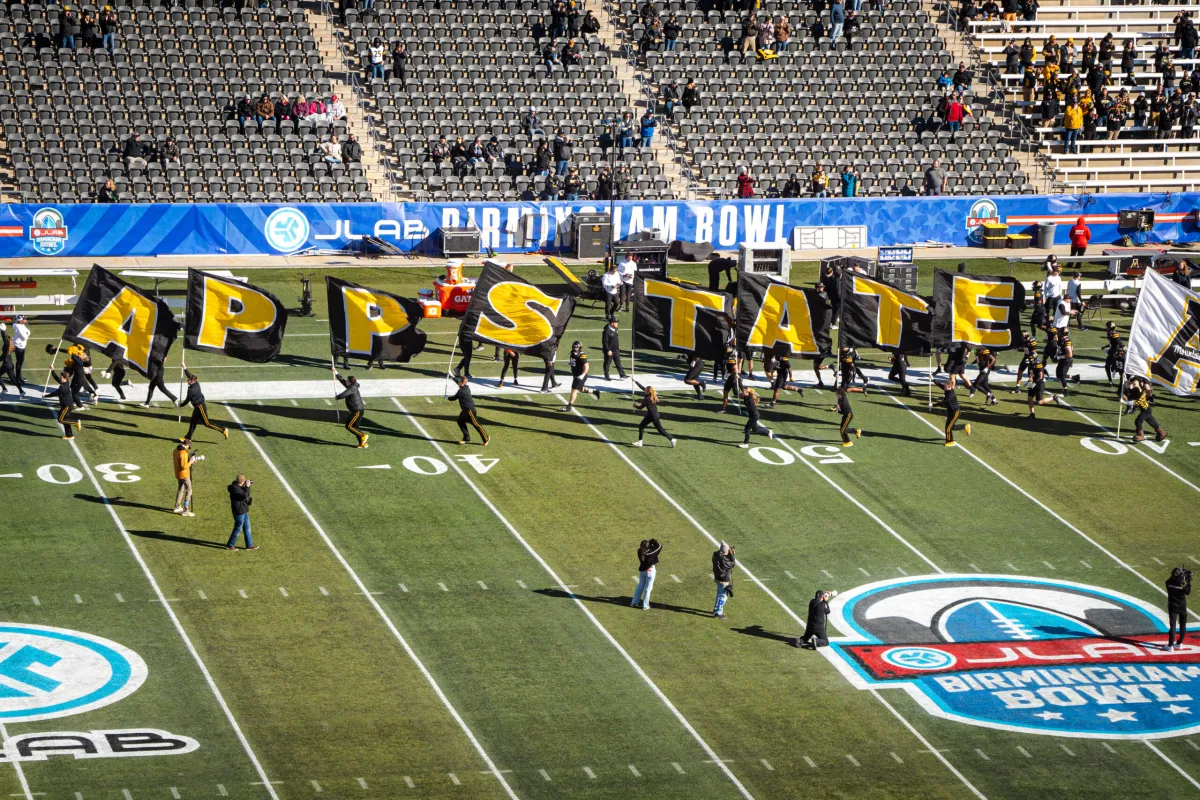
A bowl game that numerous teams turned down, before a paltry 12,092 fans among many empty seats, with rosters decimated by the ridiculous absurdity of the NCAA transfer portal, isn’t exactly a positive ending to a tumultuous season.
Appalachian State’s home opener against an FCS school, Lindenwood, netted 34,921 excited home fans packing Kidd Brewer Stadium. In Birmingham, they played in front of less than half that number, and the pictures tell the story.
And the final score in the JLab Birmingham Bowl, with Georgia Southern winning 29-10, would be just as forgettable for App State fans if it hadn’t come against the Eagles’ arch rival.
Outside of a brief skirmish where the two teams exchanged heated words and engaged in some pushing and shoving following a roughing the kicker penalty on the Mountaineers, there was little of the passion normally displayed by teams that refer to their annual preparation time as Hate Week.
Many of the players competing for App State were seldom-used backups, filling in for those starters who had already left for the transfer portal. At least most of the Eagles had stuck around for one final game.
There was the emergence of a freshman quarterback, Matthew Wilson, who displayed some special skills with his running and passing. Wilson was 12-of-22 for 128 yards passing, while dashing for 110 yards rushing and a six-yard scoring scamper for Appalachian’s only touchdown of the game.

But in this day and age of college football chaos, who knows if Wilson’s first game will also be his last in Black and Gold.
Following what in this writer’s mind was the worst season of Appalachian football in his 33 seasons covering the team, being the last team asked to the parade of bowl teams offered few benefits.
A few loyal seniors got to play got to play in one final game. Players and coaches received an opportunity for a couple of extra weeks of practice.
But the same problems that led to this year’s 5-7 regular-season record were still on full display. Questionable decisions-making and play-calling, inconsistent play on both sides of the line and the inability to perform in the game’s biggest moments.
The first meeting between the two bitter Rivals involved two star quarterbacks who combined for 700 yards passing. The Birmingham Bowl starred two teams that were a shell of the teams that met earlier in the season.
The Mountaineers had their chances to make this a competitive contest, but four pass interceptions and the continuing trend of untimely penalties ruined that possibility.
No sequence accented those facts more notably than three plays in the first half.
Trailing 7-0 after GSU scored on its first drive of the game, Appalachian got into position for a 31-yard field goal attempt by Dominic De Frietas. The freshman drilled the kick through the uprights, but ASU was called for an illegal formation penalty.
Moving backwards five yards, De Frietas’ second kick from 36 yards was caught by the brisk wind and sailed wide. But the play was blown dead because of an illegal procedure penalty on the Mountaineers and De Frietas had to kick again from 41 yards.
His third try was again hampered by the wind and fell short of the crossbar.
This was an Appalachian team that committed far too many penalties all season in similar situations. It was easy to forget how many times the Mountaineers ruined scoring threats on offense and how often they jumped offsides on defense to give up first downs on third and fourth downs defensively during the year.
With App State’s two primary quarterbacks this season, AJ Swann and JJ Kohl leaving in the transfer portal, the starting assistant fell to freshman Noah Gillon, who struggled on 4-of-7 passing for 64 yards and two interceptions.
Gillon was picked off twice in the red zone and one of Wilson’s two interceptions also came in scoring territory.
The bowl game gave Appalachian the opportunity to clear some of the bad taste from everyone’s mouths left by such a disappointing season, one where the Mountaineers only qualified for a bowl due to all the teams opting out. Instead the 5-8 campaign is the most losses for a Mountaineer squad since it went 4-8 in its NCAA transition season of 2013, the first year with Scott Satterfield as head coach.
And the loss leaves even more question marks for the Mountaineers heading into 2026. The new recruiting class was ranked as the best of the Sun Belt Conference, but recruitment rankings are far from an exact science.
There are a lot of holes to be filled through the transfer portal for Dowell Loggains as he enters his second season. A bowl win could have built some momentum for next year, but instead created more uncertainty.

THE STATE OF THE GROUP OF SIX
With the mass exodus of many of the elite schools from FCS in the past decade-plus, the changes in college football has left once-dominant programs like Appalachian and Georgia Southern in a precarious place.
And FBS newcomers like James Madison, Delaware, Sam Houston State and Missouri State are also joining that club.
Boise State made the move in 1995 and has secured some stronger footing with its move to the refurbished Pac-10 in 2026. The Broncos had remarkable success due to many factors, including the burgeoning economy of its location and some remarkable wins.
Schools like Marshall, Appalachian State, Georgia Southern and James Madison have also made their marks, most notably with the Duke’s appearance this season in the CFB Playoff.
But the early success of these programs is much, much harder to maintain in the new landscape of the NIL and the transfer portal.
Success means that larger schools come waving big contracts at coaches and now pick off players who have been developed by these schools.
Thanks to their success since joining the Sun Belt, JMU has had to hire a new coach for the third year in a row as head coach Bob Chesney was hired away by UCLA before their CFP playoff game even kicked off. After getting throttled 51-34 in a game that was determined well before halftime, seven offensive starters entered the transfer portal, meaning their entire offense that started the playoff game is either graduating or transferring.
It’s not just James Madison, either. Appalachian has now had four head coaches in the past seven seasons, and the turnover every year has taken its toll on the Mountaineers. The difficulty of maintaining a school’s culture and traditions becomes more difficult with each passing year.
With the NCAA’s Pandora’s Box opened to a new reality, its remains to be seen if any of these programs can maintain, or regain the magic that once made these teams special.

David Coulson is an executive editor for the College Sports Journal, and has covered college football for over 40 years. Present in the press box during the legendary Appalachian State upset of Michigan, his extensive coverage of Appalachian State allowed him to write about the Mountaineers’ first-ever Division I title in the book
Magic on the Mountain: Appalachian State’s Amazing Journey to the 2005 NCAA I-AA Football Championship.
Reach him at:
